|
Part One
Albert knew he would be invisible
if he were very quiet,
soft as a spring rain;
for his father
was a muggy August night,
his mother a Sicilian tempest.
So Albert learned to move
Zen-like, the soles of his Puma's
barely rippling the surface,
his shadow faint and wispy.
Albert died as he lived,
silently and without leaving a trace.
Part Two
There was a time when
living was pretty intense
for Albert so he went
to see the parish priest.
The priest, a decent sort,
but unable to see Albert's
trembling shadow,
nor his imprisoned soul,
suggested a conference
with teachers and parents.
Albert thanked him and left.
He told me later that the people
were wrong about the priest;
he did have a sense of humor.
Part Three
I loved Albert,
a prince of a very different sort,
with strong feelings about what was right,
about what was fair. And this at a time
when the only things that were right
were what we were told.
One Saturday, as we were leaving
the Strand theater's afternoon feature,
the whoops and screams of the Indians,
and the whining heroic gunfire still
ringing in our ears, Albert began to cry.
He couldn't accept what had happened.
I told him it was just a movie,
and that he didn't understand;
besides we needed to do those things.
But Albert understood,
and with each heave of his waif-thin chest,
he apologized for all of us.
Part Four
Looking like preteen cherubs
we stood in the rectory
waiting for the start
or our third mass that morning.
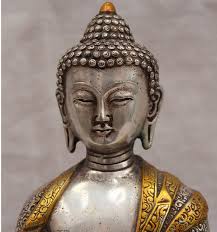
Albert said he liked Buddhism much better
because it wasn't evangelical.
Where did he get these words?
I was still struggling with the Sunday comics.
He explained, and I had to agree.
It would be nice to belong someplace
where you weren't counted
or constantly being tested.
Part Five
Me and Albert grew up on the east side,
blue collar working stiffs, mostly Italians.
Lots of excitement there.
My father was a tough, wiry little guy,
a gandy dancer for the railroad,
and if you overlooked his regular
outbursts over politics, high prices,
and his ungrateful children,
was a rather nice guy.
While Albert's dad, a first class shoe maker,
was a big, loud, mean son of a bitch,
nice enough when sober, as the saying goes,
but he used to knock Albert around a bit.
I would tell my dad, and he would shrug;
tell me "you don't go messing
in other people's things."
So one Saturday night, two weeks
into a vicious, juice sapping heatwave,
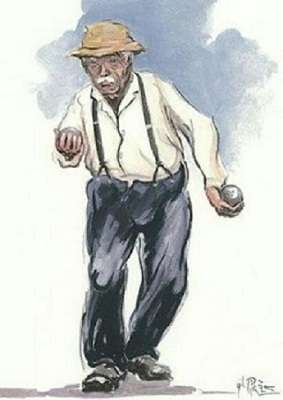
the old men were down at Yarusso's Café
drinking and playing bocce ball.
Albert's dad, upset with life I guess,
and flush with dago red, took issue
with how the game was going and kicked
over a wine laden table. In the resulting melee
old man Yarusso, wheezing through his broken nose,
barred all the active players from his café, which was akin
to the church excommunicating the unfaithful.
When the four black and whites finally arrived
there was no one around but a few peace
makers bending over Albert's dad lying
on the ground just beginning to stir after taking a hit
upside the head from a neatly thrown bocce ball.
My dad never mentioned the incident, as was his wont,
but as Albert pointed out to me,
he had a hell of an arm for such a skinny guy.
Part Six
While still a boy Albert ran his
father's shoe shop. I'd help him whenever I could,
sharpening skates, shining shoes,
and while Albert tap tapped, and cut and soled,
and I sharpened and cleaned and shined,
his father played dominoes
and drank red wine with his cronies
we called the Beaumont Street Gang.
He once told a bare bones story of
Machiavelli and then equated it to the president
and the government. Said in his casual way
that this war would never be won, and when
this president left the next one
would be the crook of crooks.
Some time later
while the nation mourned and moaned before
the nightly news, the Beaumont Street Gang
finally recognized the shoe shop prophet
by buying his father a quart bottle of anisette.
Albert just shrugged as he always did,
but I basked in his light.
Part Seven
When we were kids, me and Albert played
in his back yard where there was an old
beat up Ford squatting on blocks, with a small elm
tree growing through what was left of the canvas top.
Albert's father got a big kick out of that.
Beside the car stood an equally old pigeon coop
where his father, for many years, raised birds
for the table, until the city told him it was unhygienic,
and when their citations went unanswered,
raided the place in a crack house manner.
After his father had a stroke,
Albert found a pair of pigeons
who were in love and before long a flock
was circling the neighborhood again,
dropping droppings in its unruly way,
and the city was once again involved.
Albert just shrugged when questioned
said he thought they were racing pigeons.
His father, who was now just a shadow,
somehow showed Albert he was pleased
and suddenly it was just like old times.
Part Eight
Albert had a wonderful relationship with women.
His soft brown eyes and easy manner were enough
to keep him busy far past the time our teenage
hormones settled into a dull ache.
It was no surprise, I just couldn't figure it.
I was bigger, stronger, far more physical than he.
Could out scrap him, had more street smarts,
and once I learned the rules, could play
the game in a far more interesting way,
or so it seemed at the time.
But how I envied his aplomb,
his good-natured tolerance.
In one of the few times we talked about this,
he said, in an off hand way,
that maybe he was less needy than I.
It wasn't until years later that I realized
he was the most self contained person
I would ever know.
One expects a master's light to burn forever.
It was because he died so young
that I missed the connection.
Part Nine
Albert wrote the governor to protest
the treatment of penitentiary inmates.
Some time later he received a letter
from a prison functionary
thanking him for his concern,
and stating that everything possible
was being done to relieve the situation...
...and that they had already dismissed
two 'heads' and more changes
were in the works.
Albert commented that the lost 'heads'
would more than likely find
jobs within the federal system,
or even more likely,
with the military
because their punitory
training was invaluable.
Part Ten
I told Albert that I had blown a commitment
and because of a complicated timeline
wanted to know if I should trash the idea.
He asked me what I was afraid of?
Surprised, I puffed back -- 'nothing.'
The Buddha smile crossed his face.
If that's so, he grinned,
then the commitment should stand.
He was a prince, he was.
Part Eleven
Just before Albert left on his fatal trip,
he asked me to care for his dog Jilly
for a few days. Said he'd be back
on Tuesday, and I should watch her good
for she was depressed, wasn't eating well.
When Albert was late in coming back,
and just before I got the news that he wouldn't be,
she crawled under the back porch
and never again came out.
I didn't try to coax her or reason with her.
I figured she knew what she was doing.
Besides, I felt like crawling in with her.
Part Twelve
Albert left me a small piece of land
not far upstate; a few acres of bog
tucked back in a new growth forest.
Isolated, wonderfully frightening.
A wooden shack squatted
on the end of the car wide ridge
that snaked through the endless fog.
Melancholia hung like magnolia.
I went there when the days
began to run together,
tried to find that center.
And funny thing, I seldom felt the change
but I always felt his intent.
Epilogue
I had a dream...
...that Albert flew in from the Sudan.
He appeared strong and fit,
in spite of the horrors of the trip;
and he said nothing.
We hung around the corner for a time.
It was good just to be near him.
At the end,
he pressed lightly on that very sore spot,
I winched, then watched
as he collapsed in a heap,
disintegrated with a hissss,
his hat resting lightly atop his crumpled coat.
back
|